
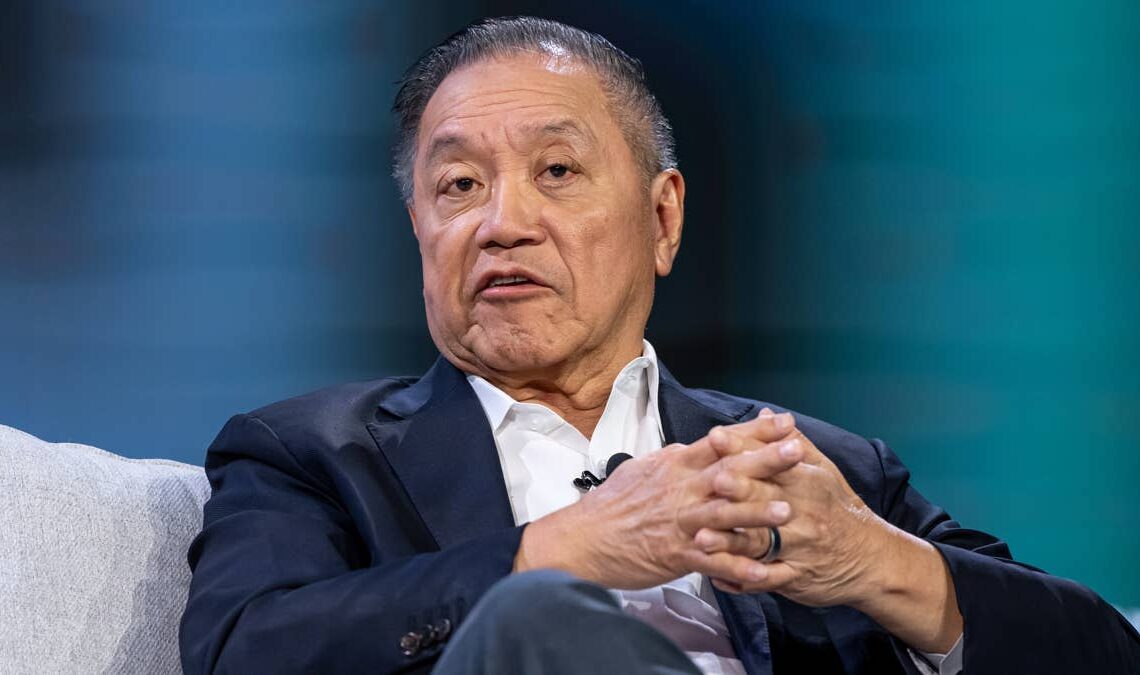
Elon Musk rarely passes up a chance at a one-liner. When Broadcom CEO Hock Tan compared many AI investors to casino gamblers, Musk replied on X to a post summarizing the remarks with five words: “No crying in the casino.”
The jab added fuel to a growing debate over how long the AI boom can last.
The exchange landed at a touchy moment for the AI trade. The Nasdaq fell 1.25% on Oct. 8 as chip stocks, including Nvidia (NVDA) and Broadcom (AVGO), took a hit after questions surfaced about OpenAI’s revenue.
Also read: AT&T CEO holds firm stance on Elon Musk’s SpaceX phone strategy
Hock Tan says many AI investors are gambling
Tan made the comments on Oct. 12 at the DBS Asia Future Forward Conference in Singapore, sharing the stage with Intel (INTC) CEO Lip-Bu Tan on a panel moderated by DBS CEO Tan Su Shan.
“A lot of investors have no clue what they are investing in,” he said, adding that some set very extreme expectations “only to find out that it’s almost like they are in a casino.”
He was just as blunt about corporate spending.
“People are just wasting money, spending tokens, trying to understand (AI),” Tan said, comparing companies to a child who burns through $10 of arcade tokens in minutes and learns nothing.
He added that OpenAI’s annualized revenue of roughly $50 billion was “by itself, not that bad” for a startup.
That OpenAI figure is exactly what rattled the market a few days earlier. OpenAI told investors its annualized revenue was approaching $50 billion at the end of September, well below the nearly $70 billion figure that had been widely reported, and AI infrastructure stocks fell on Oct. 8.
Musk has played both sides of this debate. In September, he said Anthropic CEO Dario Amodei was “right” after Amodei called for an intentional slowdown in advanced AI development.
Tan brushed that push aside, saying on Sept. 14 that the debate had not changed Broadcom’s AI forecasts “in the least.”
Bloomberg / Getty Images
Broadcom is cashing in on the boom it’s warning about
Tan’s warning carries extra weight because few companies have gained more from AI spending than Broadcom.
Broadcom reported fiscal third-quarter revenue of $29.6 billion in early September, slightly ahead of analyst estimates, with AI semiconductor revenue up 221% from a year earlier, according to its SEC filing. It guided for $21.7 billion in fourth-quarter AI chip revenue, yet shares still fell after hours.
The longer-term targets are even bigger.
Broadcom expects AI semiconductor revenue of about $115 billion in fiscal 2027 and about $230 billion in fiscal 2028. Tan also arranged a financing partnership with Apollo and Blackstone to back more than 20 gigawatts of computing capacity, a buildout that will require hundreds of billions of dollars.
That financing angle is where Tan sees the real squeeze.
“What I think might be the biggest constraint is capital,” he said in Singapore, while Lip-Bu Tan pointed to “capital and the cost of capital.” Hock Tan also said computing demand could outrun supply through 2029 or 2030, according to Benzinga.
Broadcom is deeply tied to that money chase. Broadcom has been seeking more than $50 billion in financing tied to OpenAI as tech companies race to buy chips and expand AI infrastructure.
The bill for the AI buildout keeps growing
The spending numbers explain why capital is suddenly the main topic. The largest U.S. hyperscalers are on track to spend roughly $800 billion on capital projects this year, and Goldman Sachs projects $1.2 trillion in capital expenditure in 2027, as reported by TheStreet.
Wall Street has been warning about this for months. Morgan Stanley said in February that hyperscaler AI spending was “set to exceed dot-com era telecom capex in both magnitude and length.” Its bear case was that “investment outpaces monetization for several years.”
More Artificial Intelligence:
- AI’s biggest business opportunity may not look like AI
- AI racks are outgrowing old power: 2 chipmakers have a strategy
- BofA splits software into winners and losers as AI agents arrive
The borrowing is already showing up in bond markets. Fed Chair Kevin Warsh said in September that hyperscalers raising money is part of why Treasury yields have climbed, adding that “the competition for capital is real,” according to Fortune.
Morgan Stanley expects global AI-related debt issuance to approach $570 billion this year.
Even AI believers are getting nervous about the price tag. The Financial Times reported that Big Tech firms are using guarantees to back as much as $300 billion in debt tied to AI data centers and chips.
SoftBank also raised $11.1 billion in one of the biggest high-yield bond deals ever to fund its OpenAI investment.
What investors should watch next
The cost of money is the first thing to track. The 10-year Treasury yield hit its 2026 peak of 5.37% on Oct. 7, its highest level since March 2002, which raises the bar for every project funded with borrowed money.
The biggest spenders still look well protected. The largest hyperscalers have shown little sensitivity to higher funding costs so far, while smaller and highly leveraged businesses are more exposed.
Musk, for his part, has his own chips on the table. SpaceX went public in June in what was billed as the largest IPO in history, and it absorbed xAI earlier this year. The company says xAI built the first gigawatt-scale AI training cluster.
For investors watching from the sidelines, the question is who walks away from this casino with winnings.
Related: Broadcom CEO echoes Warren Buffett with warning for investors