
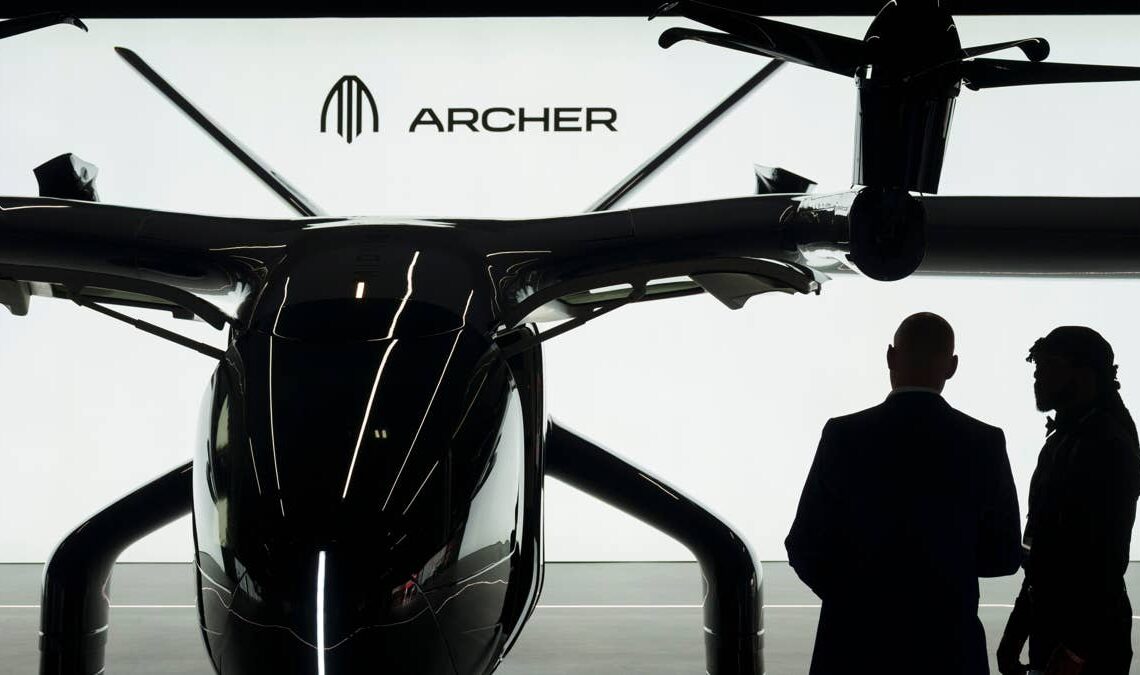
Archer Aviation (ACHR) has spent years as a pre-revenue startup, burning cash while it waits for regulators to let its air taxis carry paying passengers.
That description no longer fits.
On Aug. 10, Archer said it will buy three Boeing subsidiaries in an all-stock deal, and the market pushed the stock up 18.4% that day.
The three units are Wisk Aero, an autonomous air-taxi developer; Insitu, a profitable military drone maker; and SkyGrid, an air-traffic software platform.
In exchange, Boeing gets a large stake in Archer and becomes a strategic partner. No cash changes hands.
For investors watching the electric air-taxi race, this is the moment Archer started to look like a working aerospace and defense business.
What Archer gets from Boeing, and what Boeing gets back
The deal is a swap of assets for ownership.
Boeing will receive newly issued Archer Class A shares equal to 19.75% of that share class, plus options to buy more stock over the next four years, according to Archer.
Boeing also gets a board seat and agreed toinvest up to $55 million in an upcoming Archer funding round.
In return, Archer takes full control of three businesses that Boeing spent two decades building.
What the 3 Boeing units add to Archer
- Wisk Aero: The autonomous air-taxi program has made more than 1,700 test flights over 16 years. Archer gains its self-flying technology and removes a direct rival.
- Insitu: The drone maker builds uncrewed aircraft for customers such as the U.S. Navy. It generates more than $200 million in annual revenue across 35 countries.
- SkyGrid: The software manages air traffic in automated airspace, which Archer needs to run fleets of pilotless aircraft safely.
Boeing keeps access to Wisk’s autonomy technology through a separate licensing agreement, so it did not simply walk away from the work, according to The Wall Street Journal.
Richard Baker / Getty Images
The one thing Archer now has that rival Joby still lacks
Insitu is the reason this deal matters more than a typical technology purchase.
Most eVTOL companies, including Archer until now, have no meaningful product revenue. They spend hundreds of millions a year while they wait for the Federal Aviation Administration to certify their aircraft.
Insitu changes that. It adds more than $200 million in yearly defense revenue and positive free cash flow to Archer’s business the moment the deal closes.
More Defense Stocks:
- Boeing stock slips after CEO reveals Air Force One disappointment
- Top defense contractor scores huge U.S. Army payday, stock jumps
- Veteran analyst rethinks Palantir stock after earnings
That cash flow gives Archer a cushion its closest competitor does not have in the same form.
Joby Aviation (JOBY), the other leader in the space, is spending heavily to build its own network of takeoff and landing pads.
In its most recent quarter, Joby raised its full-year 2026 revenue guidance to a range of $115 million to $125 million, and it recently partnered with Atoms to develop vertiport sites in Florida, New York, and Texas.
Archer is taking a different route. Instead of building physical infrastructure first, it is buying defense revenue and autonomy software today, then applying that technology to passenger air taxis later.
How the deal reshapes Archer’s business model
Before this announcement, Archer had one main product: its piloted Midnight air taxi, still working through FAA certification.
Now it has four areas of activity.
Archer’s business after the Boeing deal
- Air taxis: The piloted Midnight aircraft, targeted for early commercial operations later this year under a White House pilot program
- Defense: Insitu’s drones plus Halo and Thunder, a hybrid aircraft platform Archer is developing with defense company Anduril
- Autonomy: Wisk’s self-flying technology, aimed at removing the pilot from future aircraft
- Aviation software: SkyGrid’s air-traffic system and ZEE, Archer’s AI model built for aviation
Archer plans to test this technology in military settings first, where rules are less strict, before bringing it to passenger flights once the FAA allows it.
Chief executive Adam Goldstein called the quarter an inflection point and said Archer is now a diversified platform across air taxis, drones, and AI, rather than a single-product startup.
Reading Archer’s second-quarter numbers in this new light
Archer announced the Boeing deal alongside its second-quarter results, and the two are linked.
Revenue reached $5.0 million in the second quarter of 2026, up from $1.6 million in the first quarter, an increase of about 213%.
The gain came from operations at Hawthorne Airport in Los Angeles, Archer reported.
Related: Jim Cramer says surging defense stock is a sensational buy
The company still loses money. Net loss was $263.2 million, or 34 cents per share, and Archer ended the quarter with about $1.56 billion in cash and short-term investments.
Those figures explain why the Insitu revenue matters so much.
Archer spends roughly $170 million to $200 million each quarter, so a $200 million yearly revenue stream does not erase the losses, but it slows the cash burn while Archer waits for certification.
The risks investors should weigh before buying ACHR
The deal solves one problem and creates new ones.
First, the transaction is not final. It needs antitrust clearance under the Hart-Scott-Rodino Act and is expected to close by the end of 2026, Breaking Defense reported, so the benefits are not yet locked in.
Second, this is an all-stock deal. Archer is issuing a large block of new shares to Boeing, which reduces the ownership of current shareholders by roughly 20%, The Motley Fool noted.
Third, merging three separate companies into a startup is hard. Different software systems and work cultures have to fit together, and integration often takes longer than planned.
3 things to watch before this thesis holds up
- FAA progress on the piloted Midnight aircraft, which drives Archer’s near-term revenue
- A clean antitrust review, since the deal cannot close without it
- Early signs that Insitu’s revenue and Wisk’s technology are being folded in on schedule
Wisk’s autonomous passenger technology also faces a long wait.
The FAA is unlikely to certify pilotless passenger flights for years, so that part of the deal is a long-term bet, not a 2026 catalyst.
What the Boeing deal means for Archer investors now
The stock has already moved. Shares closed at $6.26 on Aug. 11, up about 26% over five trading days, though they still sit far below the 52-week high of $14.62.
For investors, the decision comes down to what kind of company they want to own.
Archer is no longer a pure bet on air taxis arriving on schedule. It is now a mix of defense revenue, autonomy software, and a future passenger business.
That mix lowers the risk that Archer runs out of money before its air taxis reach the market, which was the biggest fear for the stock.
It does not remove the core question. Archer still has to certify Midnight, close the Boeing deal, and turn three separate businesses into one that works.
If it does, the Insitu revenue and Boeing’s backing give Archer a stronger base than any other name in the eVTOL field.
If it fails either certification or integration, the added complexity could affect the stock instead.
Related: Morgan Stanley delivers strong new verdict on RTX stock after earnings