
Louis Navellier has been active in the stock market for approximately 46 years, beginning with the publication of his quantitative research in 1980, the MPT Review. He regularly shares his thoughts with TheStreet readers in this column.
There is a false narrative out there that Asia is taking over and that the U.S. tech sector will be overpowered by Chinese AI firms and Korean memory companies. I recommend investors ignore it.
The U.S. remains the leader in artificial intelligence, and the AI data center buildout is real. Right now, AI is constrained by memory and computing restrictions, hence the backlog to build more data centers; otherwise, OpenAI, Anthropic, Grok, and other AI developers will continue to hit a computing wall.
This is why I am not worried about the narrative that Nvidia (NVDA, C) is creating its own sales through circular financing. All Nvidia is doing is asserting its market dominance.
They have pricing power, all the flexibility, and the best technology. Nvidia is my largest holding, and I have no intention of selling the stock, which I expect will be $300 by the end of this year and at least $500 by the end of this decade.
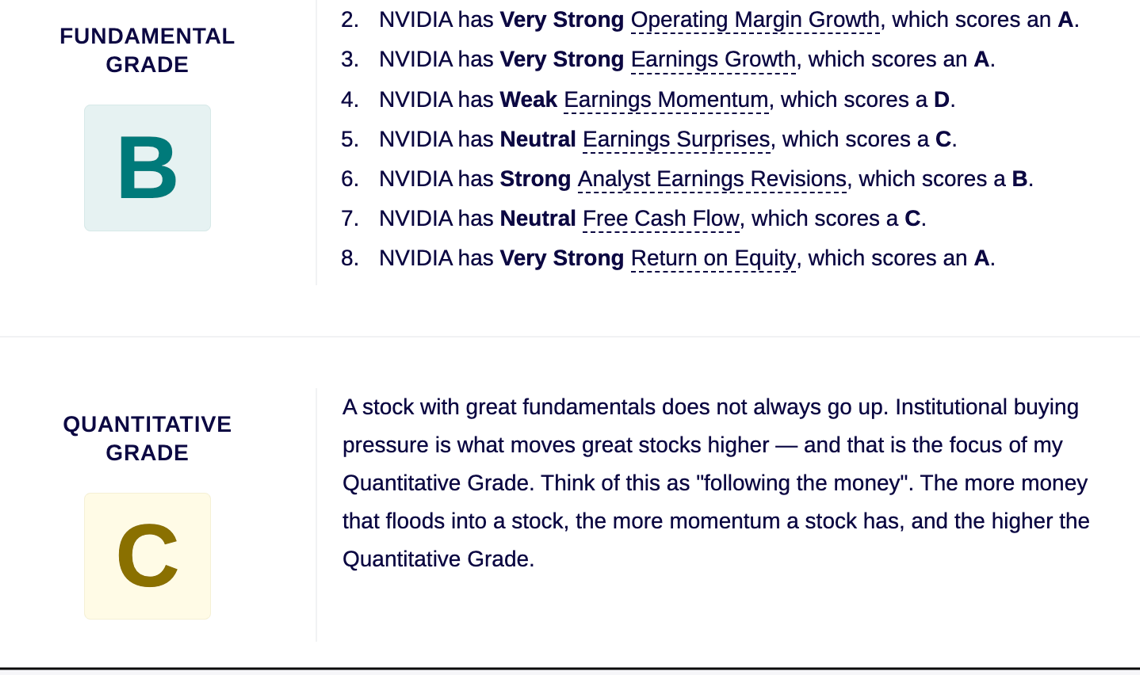
Overall, my stock grading system rates NVIDIA as a C.
Our rating systems are composed of two main components. The fundamental grade, which looks at qualitative factors such as sales growth, return on equity, among others, and a “quantitative” grade, which factors in how the company trades relative to the market.
The total grade above is weighted 70% on the quantitative score. It’s important to remember that the fundamental grade changes each quarter, and the quantitative grade changes each day.
Related: Backlog Mania: Stocks to Watch This Earnings Season
We have three weeks of earnings coming out. We need to let the earnings come out and do their thing rather than worry about the market’s daily gyrations.
The market has no patience for disappointing earnings
As second-quarter earnings reports unfold, fundamentally superior stocks are being rewarded, while companies with disappointing results are being punished.
Tesla (TSLA, D) and SpaceX (SPCX, Not Rated), for example, have recently weighed on the broader stock market.
Although Tesla continues to report strong sales, its operating margins are collapsing, and the company now has negative cash flow as it ramps up production of the Optimus robot, initially designed for factory use.
My stock grading system rates Tesla as a D.
Meanwhile, SpaceX has declined approximately 50% from its highs and is not expected to become profitable until late 2027 or 2028.
Money managers who have “bet the ranch” on Elon Musk, including Ron Baron and Cathie Wood, consequently, have negative year-to-date returns.
We are in the midst of a strong earnings announcement season, and the stock market has little patience for companies that fail to announce strong sales, earnings, positive surprises and guidance.
Nvidia is not Tesla or SpaceX.
Related: Tesla sales rebound hides costly problem for investors