
Retirement investors haven’t had a lot of reasons to complain about stocks in 2026.
Through August 21, according to Yahoo Finance, the S&P 500 was up 12.1% year-to-date and 10.7% over six months, compared with the Nasdaq Composite, which had gained 12.6% and 14.1%, respectively. Moreover, the Dow was up 10.8% this year and 6.5% over six months. That said, veteran investor Jim Cramer just flipped the script on one of retirement investing’s oldest assumptions.
It comes at a point when, despite the market jitters, staying in stocks has paid off. However, the market’s choppiness and elevated bond yields continue to raise questions about how long the rally could last.
At the same time, as I covered previously, Cramer is worried about a flood of IPOs that could impact returns and trigger market gyrations.
For retirees, the calculation is different. Protecting savings matters as much as growing them; that’s why generations of investors continue to lean on portfolios that gradually lower stock exposure as retirement approaches.
Cramer now argues that balance might be too conservative, explicitly saying on the August 21 episode of Mad Money that he has become more aggressive in his views.
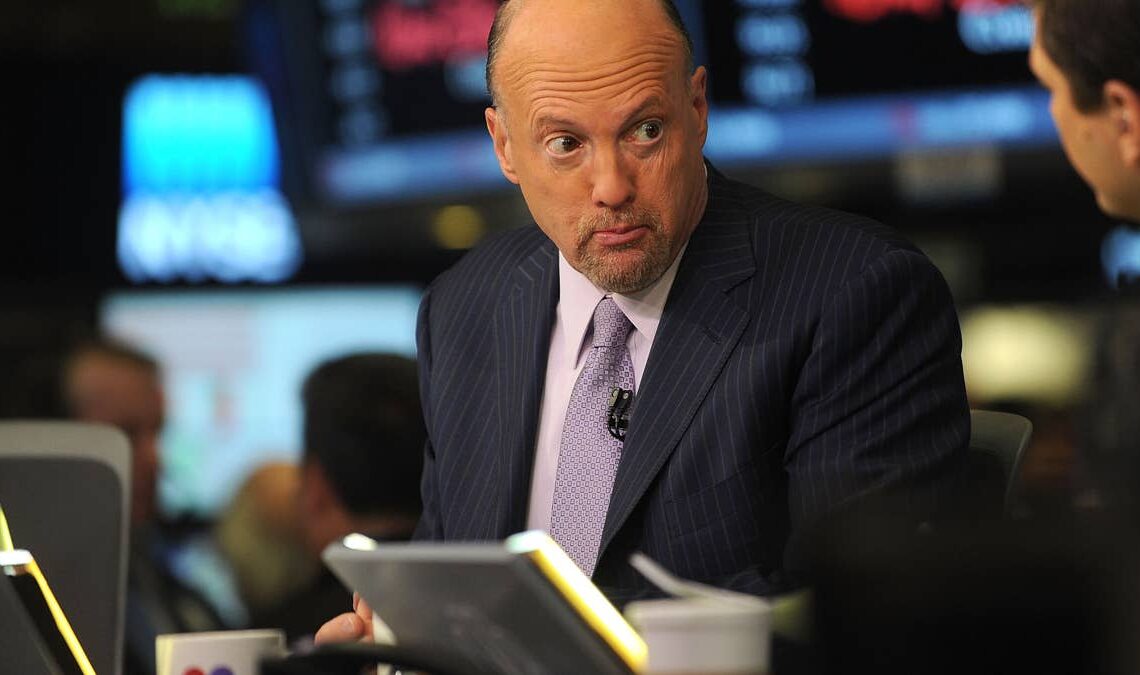
Brad Barket/Getty Images
Cramer breaks from traditional retirement playbook
Cramer didn’t hold back when a caller quizzed him on whether the traditional 60/40 retirement framework still made sense.
More Jim Cramer:
- Jim Cramer has terrifying one-word message for tech stock investors
- Jim Cramer says he’s steering clear of one popular stock
- Jim Cramer reveals 4 surging chip stocks he likes best
“I’m blowing out all that,” he said. “We want to bet with ourselves.”
His reasoning was that people are living a lot longer, meaning retirement portfolios might need to keep growing for much longer than investors previously assumed.
Consequently, Cramer got a lot more aggressive with allocation that older investors might have expected.
“When you’re 60-70, I still think that’s young, and I think you should have 70% stock,” Cramer said. He acknowledged the shift, adding, “I know that’s higher than what I’ve usually said.”
Essentially, Cramer is saying that the longevity risk could be as dangerous as market risk. A retiree who becomes conservative too early will reduce short-term volatility but also forgo decades of potential compounding.
He also questioned whether bonds could do enough heavy lifting.
“I just think that you’re not going to get the return from bonds that people want”.
His claims are backed by the data, with bonds barely moving the needle in 2026. The Bloomberg U.S. Aggregate Bond Index was up just 0.1% through August 13, trailing the S&P 500’s double-digit gains.
His broader comments during the show reinforced his long-term slant.
Another caller during the show told Cramer that his retirement money with a 20- to 30-year horizon was sitting in a money-market account earning 5%.
Cramer recommended gradually moving the funds into stocks rather than investing everything at once. In doing so, he says it would be best to put one-twelfth to work each month and invest much more during a particularly bad month.
Why 60% stocks and 40% bonds?
The 60/40 portfolio became popular as it looks to balance growth with protection.
Stocks act as accelerators, while bonds are like brakes. With 60% of a portfolio in stocks, investors are still meaningfully part of stock markets when they rise. The remaining 40% in bonds will cushion the damage when stocks tank.
If stocks tank 25%, an investor all-in on stocks takes the full hit. A retiree holding a substantial bond allocation might see a smaller decline, assuming bonds remain relatively stable.
So the 60/40 allocation isn’t designed to produce the highest possible returns.
It’s designed to generate enough growth without turning every stock market crash into a retirement crisis.
That said, no investor invested this balance.
Arguably, Harry Markowitz offered much of the intellectual foundation. His Modern Portfolio Theory, introduced in 1952, formalized the idea of combining assets with different risk-return profiles to improve the risk-return balance.
Benjamin Graham, Warren Buffett’s mentor, pushed investors toward balancing stocks and bonds. Graham suggested keeping 25% and 75% in stocks, with roughly 50/50 serving as a neutral starting point.
However, that traditional model has a weakness.
Bonds don’t always protect investors when stocks fall. For instance, in 2022, both asset classes dropped sharply, showing that the portfolio’s apparent shock absorber could sometimes drop just when retirees need it most.
Retirement investors have more than one playbook
The 60/40 portfolio is just one of the strategies retirees use to try to balance growth and safety.
The more aggressive investors might use a 70/30 or even 80/20 mix, keeping much more money in stocks and less in bonds. That strategy can yield remarkably stronger long-term returns, but it also involves taking big hits when markets fall.
Another simpler result is to subtract your age from 100 to estimate how much should be in stocks.
Under this framework, a 70-year-old would need to hold just 30% in stocks. Newer versions make use of 110 or 120 minus age because people are living longer, but Cramer’s 70% stock call for people in their 60s and 70s looks a lot more aggressive by comparison.
Target-date funds also follow a similar idea, where investors start with lots of stocks when they’re young, but then gradually shift to bonds as retirement gets closer.
At the same time, the bucket strategy takes a different approach.
Retirees might keep a few years of spending money in cash, another portion in bonds, and the rest in stocks. The goal is to avoid selling off stocks in a crash just to cover everyday expenses.
Then there’s a 4% rule, which focuses on how much investors can safely withdraw each year.
Other approaches involve simple three-fund portfolios built from U.S. stocks, international stocks, and bonds, or “floor-and-upside” strategies that first aim to protect essential expenses before investing the remaining money much more aggressively.
Related: Warren Buffett’s Berkshire makes backdoor SpaceX play