
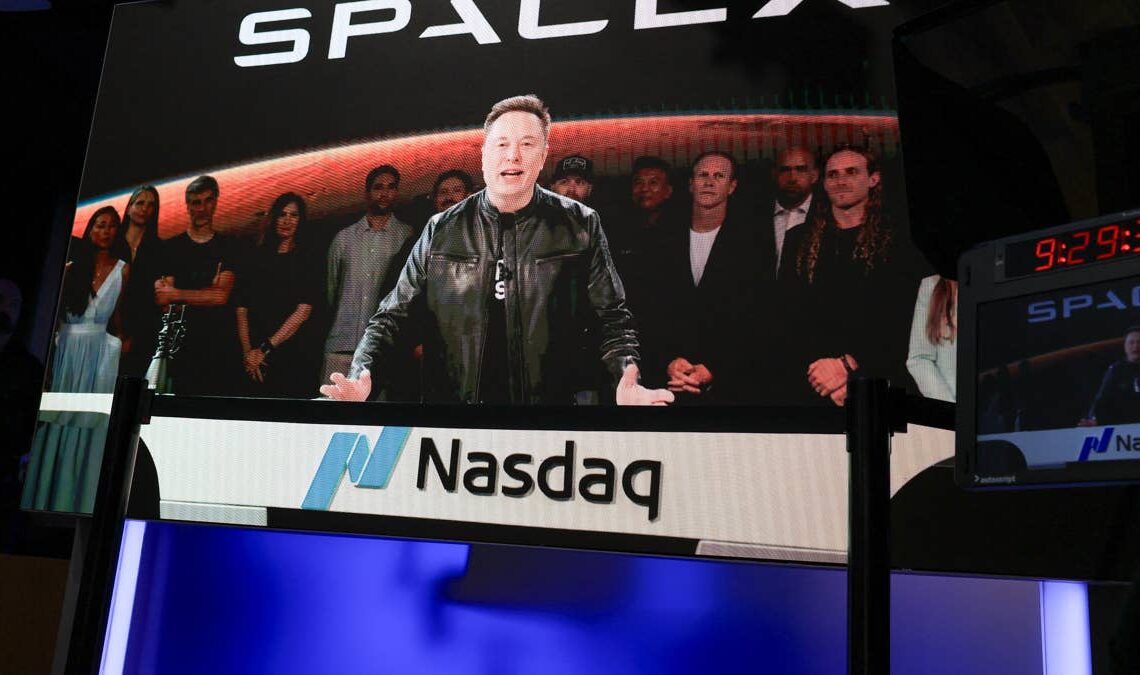
A revenue target posted on X (the former Twitter) on Aug. 27 would require a private company to grow faster and larger than any business in history. The number is $3.5 trillion. The timeline is 2033. And the person who posted it is the company’s founder.
Elon Musk made the forecast while responding to discussion of Morgan Stanley’s latest SpaceX research on X. His position: SpaceX could hit roughly $3.5 trillion in annual revenue by 2033.
Morgan Stanley’s model reaches the same milestone around 2040, seven years later. Musk moved the finish line forward, Seeking Alpha reported.
What Musk’s $3.5 trillion SpaceX forecast actually means
The $3.5 trillion figure is annual revenue. Not a market cap. Not a valuation. Revenue is what comes in from customers before expenses, interest, and taxes are taken out. A company can generate enormous revenue without generating commensurate profit.
SpaceX’s second-quarter revenue was $7.81 billion, up 92% from a year earlier. Connectivity was the largest segment at $4.29 billion. AI contributed $2.56 billion, making it the second-largest and fastest-growing line.
SpaceX:
- Morgan Stanley doubles down on SpaceX stock for investors
- SpaceX analyst plots path to bold $100 billion claim
- JPMorgan resets SpaceX price target after earnings
Annualizing the Q2 figure gives a revenue run rate of approximately $31 billion. Getting from $31 billion to $3.5 trillion by 2033 means growing revenue by roughly 112 times in seven years. That works out to approximately 96% compound annual growth, every year, for seven straight years.
No company of meaningful size has ever done that. Amazon and Nvidia both had extraordinary growth runs, but nothing close to 96% compounded annually for seven straight years.
Musk’s forecast assumes a growth rate that outpaces anything in modern corporate history, sustained for nearly a decade.
How Starlink and AI revenue would need to scale
Connectivity is currently SpaceX’s biggest revenue line. The $4.29 billion from Q2 is driven primarily by Starlink’s satellite internet operations. It is a recurring-revenue business that collects subscriptions from consumers, airlines, governments, and enterprises.
That changes SpaceX’s model from a company that earns money when it launches rockets to one that earns money continuously from a global network.
For Musk’s target to be remotely plausible, Starlink needs to grow from a large satellite-connectivity provider into something that competes with the world’s biggest technology and telecommunications companies. That means adding subscribers in every market, expanding enterprise services, building out the satellite network, and defending against competing low-Earth-orbit systems from Amazon and others.
AI is SpaceX’s second revenue source and the faster-growing one. The company reported $2.56 billion from AI in Q2 alone.
The components of that AI revenue are not broken out publicly. It likely includes data-center capacity, compute services, and enterprise AI contracts.
To contribute meaningfully to trillions in revenue, it would have to grow into a major cloud and AI business while competing against Microsoft, Google, Amazon, and a field of well-funded startups.
Timothy/Getty Images
Why Starship is the key variable in Musk’s 2033 forecast
The piece of Musk’s forecast that requires the most belief is Starship.
SpaceX has announced a $100 billion spaceport in Louisiana. Construction is set to begin in 2027, and the first Starship launch is targeted for 2029.
The facility is designed to eventually support thousands of launches per year, with Musk saying it would ultimately enable more than 30 Starship flights per day, Fortune reported. Morgan Stanley’s model reportedly assumes a future network capable of exactly that kind of launch cadence.
The economic logic is straightforward. Dramatically lower launch costs and dramatically higher launch frequency could create markets that do not currently exist at scale: space-based data centers, orbital communications infrastructure, in-space manufacturing, large-scale cargo delivery and settlement projects.
None of those markets is close to generating trillions in revenue today. Every one of them would need to develop at extraordinary speed.
SpaceX spent $18.37 billion on capital expenditures in the second quarter alone, TechCrunch reported. That money is going into satellites, data centers, AI infrastructure, launch systems and future construction.
Large capital expenditures are acceptable when they produce sustained revenue and strong returns. They become a problem if revenue does not keep pace or if the underlying markets take longer to develop than the spending requires.
What investors should watch to evaluate the SpaceX forecast
Musk’s $3.5 trillion figure is too far out to evaluate on a single earnings report. The more useful exercise is tracking the intermediate milestones that would need to fall into place for the forecast to stay credible.
Starship’s launch cadence matters more than almost anything else in the long-term model. If the Louisiana spaceport opens on schedule in 2027 and hits its first launch target in 2029, that gives the commercial market-creation story a foundation. Delays compress the timeline and push the 2033 target further out of reach.
Starlink subscriber growth and average revenue per user are the near-term signals. If connectivity revenue continues growing at or near Q2’s pace, it validates the idea that Starlink can reach the kind of global scale Musk’s forecast requires.
AI revenue growth and enterprise adoption will tell investors whether the AI business is developing into a genuine platform or remains a smaller-scale services operation. The Q2 figure of $2.56 billion is substantial, but the path from that to hundreds of billions in AI revenue annually requires something that looks very different from today’s product offering.
Capital expenditure versus revenue growth is the discipline signal. SpaceX is spending heavily before cash flow catches up. The longer that gap persists without accelerating revenue growth, the harder the long-term model becomes to justify on financial fundamentals.
Related: JPMorgan doubles down on SpaceX verdict on key update