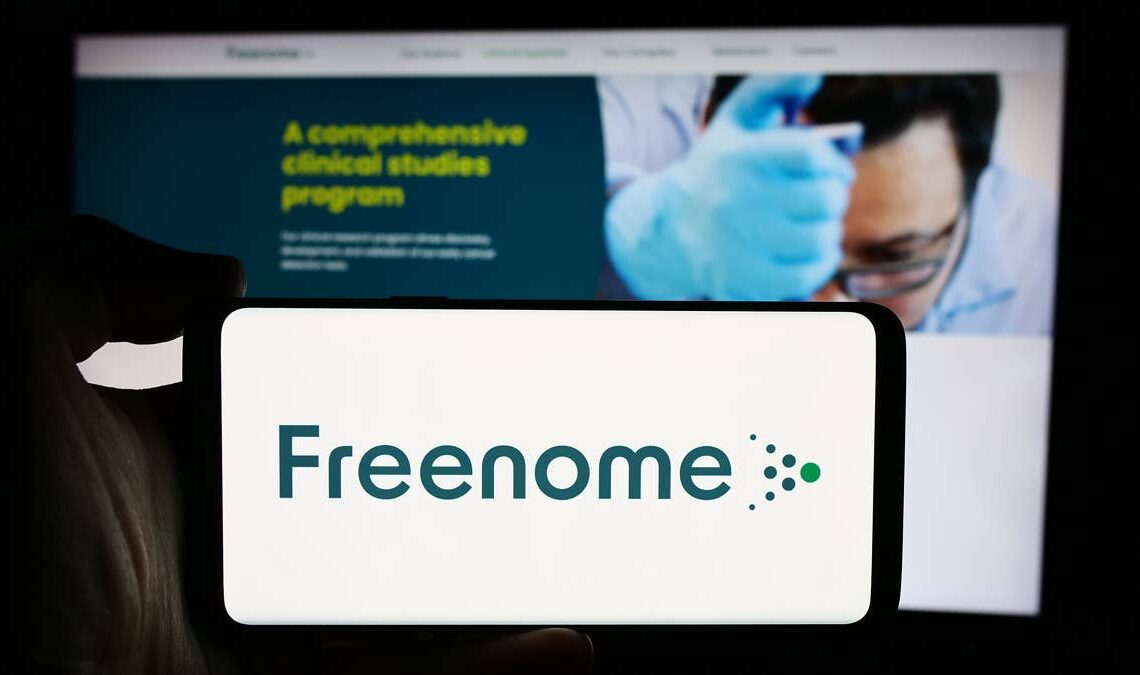
Freenome (FRNM) only started trading publicly via a Special Purpose Acquisition Company, or SPAC, deal a few weeks ago on July 21, 2026.
While Freenome isn’t nearly as familiar to investors as large drugmakers that usually dominate healthcare headlines, that may change now that a major Wall Street firm has initiated coverage and assigned a particularly strong forecast.
On August 17, 2026, Jefferies analyst Tycho Peterson started coverage of Freenome Inc. with a ‘Buy’ rating and a $17 price target, CNBC reported.
Shares jumped sharply in response, raising an obvious question: Is there something real behind the move, or is this just excitement around a fresh listing?
The answer comes down to what the company has already built, and what still has to go right from here.
Why Jefferies put a Buy rating and a $17 target on Freenome stock
Jefferies’ target sits well above where the stock traded before the call.
Freenome closed at $11.56 the previous session, so the target implies a roughly 47% increase from that level, Investing.com reported.
More Healthcare Stocks:
- Morgan Stanley uncovers major Bristol Myers stock signals
- Goldman Sachs says one number will move Eli Lilly stock
- BofA stays bullish on Gilead after a strong HIV signal
Investors moved fast on the news, with the stock jumping more than 12% to close at $13.00.
Peterson’s case centers on Freenome moving from a research company to a commercial stage company.
He told clients Freenome is “uniquely positioned,” with a multi-year growth ramp still ahead of it, CNBC noted.
What Freenome actually does
Freenome develops blood-based tests that look for early signs of cancer.
A patient gives a normal blood sample, and the company’s platform scans it for warning signals.
This matters because many people skip standard cancer screening.
A colonoscopy takes preparation and time, and a stool-based test puts some patients off. A simple blood test removes those concerns.
The company’s lead product is a colorectal cancer test called SimpleScreen.
Freenome expects it to compete with established options like Cologuard from Exact Sciences (EXAS) and Shield from Guardant Health (GH), Investing.com reported.
That is the core of the near-term business. The longer-term plan reaches much further.
SOPA Images / Getty Images
The Abbott, Roche partnerships behind the bullish call
Freenome is not trying to sell its colorectal test alone. It relies on two outside partners to reach patients and doctors.
Abbott Laboratories (ABT) handles U.S. commercialization for the colorectal cancer test.
Under the deal, Freenome received a $100 million milestone payment when the test won FDA clearance, according to MedTechDive.
Abbott provides a large sales force and deep relationships across hospitals and clinics, something a young company cannot build overnight.
Roche Holding (ROP) covers international markets and has exclusive rights outside the U.S. to develop “kitted” versions of Freenome’s tests.
These packages combine the software and lab materials together, so smaller regional labs can run them without needing a large, centralized processing facility, Freenome confirmed.
Roche is also a major investor in Freenome, having led a $254 million funding round in 2024.
These deals shape the whole call. Jefferies pointed to royalties, milestone payments, and new cancer tests down the road as the ways value can flow to shareholders over time.
From lung cancer to ten more tests: The expansion plan
Colorectal cancer is the starting point, not the finish line.
Freenome plans to widen its platform into other cancers, where the patient pools are far larger.
Lung cancer is next in line.
The FDA granted Breakthrough Device Designation to Freenome’s SimpleScreen Lung test in August 2026, according to the company’s press release.
Related: UnitedHealth CFO sends stark warning after earnings
The status is meant to speed the review of promising devices.
The company aims to cover more than ten types of cancer over time, Investing.com reported.
That is the source of the long-term optimism, since each new test adds a fresh potential revenue stream.
None of that is guaranteed. Every new test still needs clinical data and regulatory clearance before it can be sold.
The timeline Freenome investors should track
Freenome moved from a private company to a public one in a matter of weeks, and its calendar is packed.
Here are the dates that matter most.
Key Freenome milestones and what they mean
- July 20, 2026: Freenome closed its merger with Perceptive Capital Solutions Corp., raising more than $300 million in gross proceeds through a private placement, according to the company’s press release.
- July 21, 2026: Shares began trading on the Nasdaq under the ticker FRNM.
- July 27, 2026: The FDA approved the Freenome and Abbott SimpleScreen colorectal cancer blood test.
- August 12, 2026: The FDA granted Breakthrough Device status to the lung cancer test.
- Fall 2026: Freenome and Abbott plan the broad U.S. launch of the colorectal test.
- Late 2027 or 2028: A U.S. Preventive Services Task Force review is expected.
That last date is very important.
If Freenome’s test gets included in the national screening guidelines, most insurance plans will start covering it.
Wider coverage means more people can get the test, and that means more sales for Freenome.
What still has to happen before the stock reaches $17
Jefferies’ $17 target is not automatic. Three things need to go right first.
The fall launch needs to go smoothly
Freenome and Abbott plan to roll out the colorectal test widely this fall.
If doctors and patients are slow to adopt it, revenue will be delayed, and the company will burn through cash faster.
Freenome needs a win from federal health regulators
The U.S. Preventive Services Task Force reviews cancer screening tests and decides which ones it recommends.
Freenome already earned a spot in the American Cancer Society’s guidelines, Investing.com reported. But a recommendation from the federal task force is the bigger prize.
That kind of endorsement is usually what convinces insurance companies to cover a test widely, which means more people can get it without paying out of pocket.
The lung cancer test needs to keep clearing FDA hurdles
Lung cancer screening would open up a much bigger group of patients than colorectal cancer alone.
But the test is still working its way through development and regulatory review, so this part is not proven yet.
The risks that could keep Freenome stock from getting there
Freenome is small and still new to the public markets. That comes with real financial risk, so investors should size any position carefully.
Here’s the current financial snapshot:
- Revenue: About $34 million over the last twelve months.
- Profit: None yet. The company is still unprofitable.
- Why: It’s spending heavily to launch its test commercially this fall.
- Market value: Around $1.3 billion.
Early-stage biotechs like this one burn through cash quickly. If the fall launch is slow to catch on, two things could happen.
Freenome might need to sell more stock to raise money. That would reduce the value of shares that current investors already own.
If insurers are slow to cover the test, the company’s cash could run low faster than expected.
Freenome also isn’t alone in this space. Exact Sciences and Guardant Health already sell their own colorectal screening tests.
Both have longer relationships with doctors and insurers, which gives them a head start.
What this means for investors
Freenome is a high-risk, high-reward stock. That is the simplest way to describe it.
The bull case is strong. Freenome has a broad testing platform and two experienced partners in Abbott and Roche.
The risk is also just as real. The company has never proven it can sell a test at scale.
The practical advice for most readers is to wait and watch before you act.
The fall launch will tell you a lot. So will the next earnings report.
Both will show whether doctors and patients are actually using the colorectal test, not just whether Wall Street likes the story.
Remember that one analyst’s price target is not a guarantee.
Tycho Peterson at Jefferies sees a path to $17 a share. That path still depends on execution that has not happened yet.
If you are considering the stock, here are two steps to consider:
- Wait for sales data. Wait for the fall launch numbers before you buy.
- Keep any position small. Early-stage biotech stocks can swing sharply on a single earnings report, so size your investment so a bad quarter would not hurt you badly.
Freenome has done the early work. It built the technology, lined up its partners, and won FDA approval.
The next step is the hardest one. It has to prove people will actually use the test.
Related: Jim Cramer crowns one surging sector the hottest in the market