
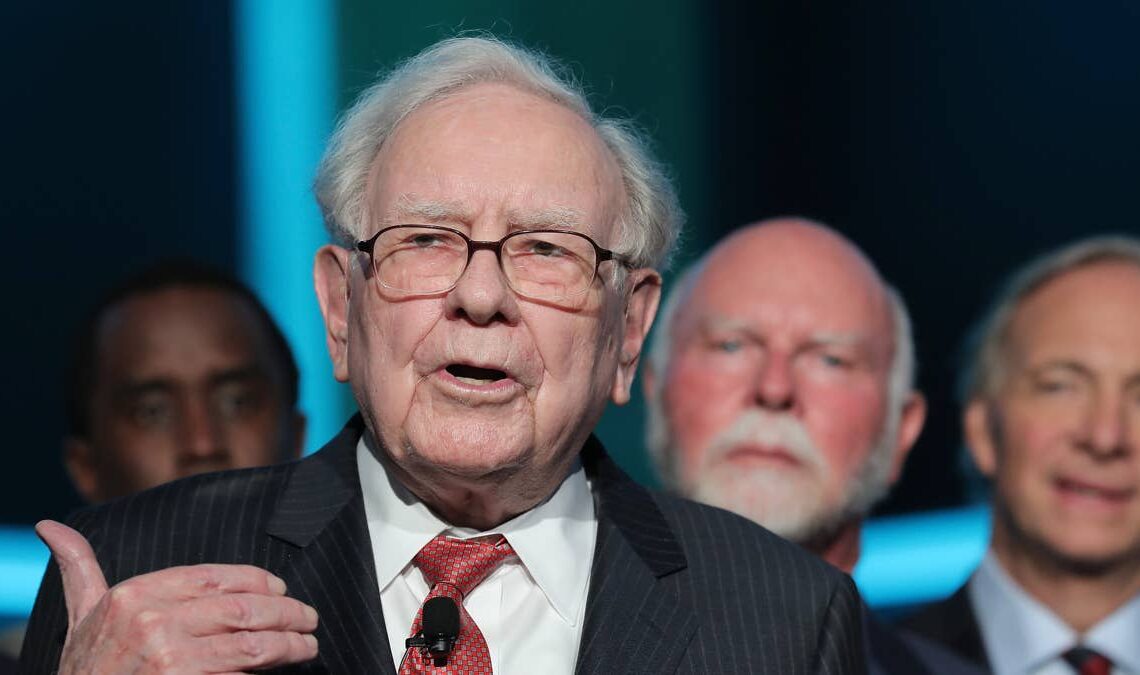
Berkshire Hathaway is sitting on $397.4 billion in cash. That number is larger than the market value of ExxonMobil. It exceeds the GDP of South Africa. It is the largest liquid reserve in the company’s history. Berkshire has been a net seller of stocks for more than three years and has not found a major acquisition it considers worth doing.
The person who built that cash pile sat down with CNBC’s Becky Quick during the Berkshire Hathaway annual meeting in May 2026. The S&P 500, Nasdaq Composite, and Dow Jones Industrial Average have all hit fresh records this year, fueled by optimism around artificial intelligence and a strong earnings season. During the meeting, Warren Buffett, 95, said the market is in the middle of a gambling boom. He made clear he sees more of the casino than the church in today’s market.
Warren Buffett says the stock market is in a gambling mood
Buffett compared financial markets to a church with a casino attached. The church is long-term investing. The casino is short-term speculation. He has used the analogy for years. What changed, he said, is that the casino has gotten much more crowded.
“We’ve never had people in a more gambling mood than now,” Buffett told CNBC. He pointed to one-day options trading and prediction markets as examples of activity he does not consider investing or speculating. He called it gambling. He also said that many prices in the current market “will look very silly” in hindsight, though he stopped short of predicting a specific crash or timeline.
More Warren Buffett:
- Warren Buffett reveals he broke his own investing pattern
- Warren Buffett has a blunt take on today’s market
- Warren Buffett pulls no punches on stock market for 2026
Berkshire ended Q1 2026 with a record $397.4 billion in cash and Treasury bills. New CEO Greg Abel has continued the same selling pattern Buffett ran for years. Berkshire has been a net seller of equities for more than 14 consecutive quarters. TheStreet reported that Buffett has said he is not finding enough attractive opportunities to put the capital to work. The cash pile is not idle. Berkshire earns roughly $12 billion a year in interest on its Treasury bill holdings at current yields.
The Buffett indicator and CAPE ratio are both flashing red
The Buffett indicator measures total U.S. stock market value as a percentage of GDP. As of late July 2026, it sat at 234.3%, according to GuruFocus. In a 2001 Fortune article, Buffett said investors are “playing with fire” when the ratio nears 200%. It is now more than 30 points above that level. GuruFocus notes the ratio sits 41.6% above its long-term average of 165.5%.
The Shiller CAPE ratio stood at roughly 41.9 as of early August, according to The Motley Fool. The CAPE divides S&P 500 prices by 10 years of inflation-adjusted earnings. The historical all-time high was 44.2, set in December 1999 at the peak of the dot-com bubble. The current reading is the second highest ever recorded. The long-term average sits near 17. The current reading is more than twice that.
J. Countess/Getty Images
What happened the last time valuations were this high
The CAPE first crossed 30 in 1996. The S&P 500 kept rising for four more years before the crash. Valuation extremes do not set a specific date for a correction. They do have a strong historical relationship with weaker returns over the following decade.
After the dot-com peak in March 2000, the S&P 500 needed more than seven years to recover its previous high. The Nasdaq took even longer. Investors who bought technology stocks near the peak in 1999 waited over a decade to get back to even. Many never did.
The current environment is different in at least one important way. The largest companies in the S&P 500 are generating real profits at enormous scale. Apple, Microsoft, Nvidia, and Alphabet reported combined profits of more than $400 billion in the most recent fiscal year. That was not true of the companies driving the dot-com bubble. Most of them had little or no revenue. Buffett acknowledged the difference in July, when he told CNBC he personally initiated Berkshire’s investment in Alphabet, calling it one of the stronger businesses he has looked at.
What Buffett’s warning means for long-term investors
Buffett has not told investors to get out of the stock market. He said prices for “an awful lot of things will look very silly” in hindsight. He is saying many individual assets are priced as if nothing can go wrong. That is not the same as calling a crash.
The S&P 500 has returned more than 700% since 2000 including dividends, living through the dot-com crash, the 2008 financial crisis, and a global pandemic. Investors who stayed in through all of it came out far ahead of those who exited at the first sign of stretched valuations. Buffett’s own 2001 warning about the Buffett indicator came three years before markets recovered from the dot-com collapse.
Buffett’s own record makes the same case. Berkshire has been cautious for years and still holds enormous equity positions. Apple remains its largest holding. He is not out of the market. He is out of the parts of the market he considers overpriced. That is the actual message he delivered in May 2026 and repeated in July: spend less on gambling, more on investing.
Related: Warren Buffett keeps pointing at the same ETF for a reason