
Why Are Traders Betting on SpaceX Before Its IPO?
Crypto exchanges are giving traders a way to bet on SpaceX’s future share price before the company goes public, drawing billions of dollars into a new class of derivatives known as pre-IPO perpetual futures.
The contracts have no direct link to SpaceX shares. Instead, they are priced with reference to the company’s latest disclosed pre-IPO valuation and trade like crypto perpetual futures, rolling over indefinitely while allowing leveraged exposure to price moves.
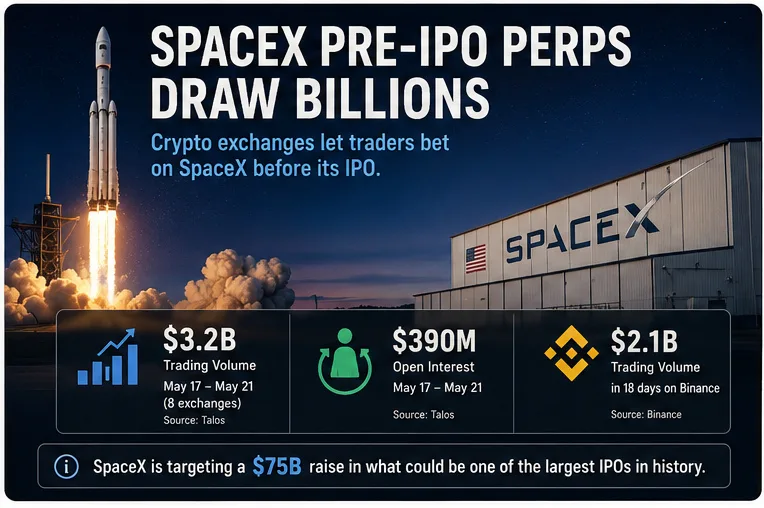
The rise of SpaceX-linked pre-IPO perps comes as global markets prepare for a potential blockbuster listing. SpaceX is aiming to raise a record $75 billion to fund expansion, including Elon Musk’s long-term ambitions around Mars and space-based data centers.
Demand has been immediate. There was about $3.2 billion in trading volume and $390 million in open interest on SpaceX pre-IPO perps from May 17 to Wednesday, according to data provider Talos, which tracked activity across 8 exchanges. Binance said its SpaceX pre-IPO perps generated $2.1 billion in trading volume in 18 days, though it declined to break the figure down by region.
Why Are Crypto Exchanges Pushing Into Pre-IPO Markets?
The products are part of a broader push by crypto exchanges into markets traditionally controlled by Wall Street. Binance, Coinbase, and Hyperliquid are among the platforms offering or supporting these instruments, placing crypto venues closer to the center of equity-linked speculation before major private companies list.
The timing matters. A wave of large IPOs is expected to include SpaceX, Anthropic, and OpenAI. Those companies have become some of the most sought-after private-market names, but direct access is typically limited to venture funds, institutional investors, employees, and selected secondary-market participants.
Pre-IPO perps offer a different route. Supporters argue they provide price discovery and allow more traders to gain exposure to expected public-market gains. But the contracts are generally not available to U.S. investors and do not provide ownership of shares, voting rights, dividends, or a claim on the underlying company.
Crypto exchanges make money from the products through market-making and fees. The commercial incentive is clear: highly watched private companies create trading demand before formal IPO access is available. The risk is that traders may treat a synthetic contract as if it were close to owning the stock.
Investor Takeaway
SpaceX pre-IPO perps are not shares and do not give investors ownership in the company. They are leveraged derivatives tied to expectations around a future listing, making liquidity, pricing, and contract design central to the risk.
What Makes These Products Risky?
Pre-IPO perpetuals are risky because they combine private-market uncertainty, leverage, and thin liquidity. Traditional crypto perps can offer leverage as high as 100-to-1, while recently launched pre-IPO perps are usually capped at 3x to 5x, analysts said. Even at lower leverage, price moves can be sharp because the contracts are not anchored to freely traded shares.
The SpaceX contract has already shown that volatility. The price of SpaceX pre-IPO perps has fallen from above $200 to around $160 in less than a month, according to Kaiko price data. SpaceX shares are due to price at $135 apiece.
“This pre-IPO perpetual isn’t really anchored towards anything other than speculation,” said Kaiko analyst Laurens Fraussen.
Fraussen also linked the trend to the growth of high-risk retail products across crypto and prediction markets. “The pre-IPO thing is, alongside prediction markets, a good example of where the world is heading… it’s like the hyper-gambler-isation of everything.”
The World Federation of Exchanges warned that buyers may assume they are getting exposure with safeguards similar to listed products, even though price formation may be less robust. “These are fundamental principles and we will work this issue into our dialogue with regulators,” a WFE spokesperson said.
How Could This Pressure Wall Street Incumbents?
The emergence of pre-IPO perps has intensified the clash between crypto venues and traditional exchanges. News that U.S. regulators would approve crypto perpetual contracts was enough to pressure shares of Intercontinental Exchange, the parent of the New York Stock Exchange, as investors weighed the long-term competitive threat to incumbent bourses.
The concern is not only crypto perps. Investors are watching whether similar structures could expand into equity-linked products, especially around high-demand private companies. If crypto exchanges can build liquid synthetic markets around pre-IPO names, they could capture trading activity before traditional exchanges host the actual listings.
That threat remains uncertain because regulators may take a harder look at products that resemble equity exposure without the disclosures, custody rules, and investor protections attached to listed securities. The lack of transparency around who is trading these markets adds another layer of uncertainty.
“It’s also very difficult to know who’s active in these markets, whether it’s your retail trader punting £10 or a proprietary trading desk of a hedge fund taking a position,” said Philippe Noeltner, a lawyer at A&O Shearman. “It’s better not to assume that these are only retail traders.”
For traders, the SpaceX frenzy shows how crypto market structure is moving into private-company speculation. For regulators and exchanges, it raises a harder question: whether synthetic access to pre-IPO names can grow without turning private-market demand into another leveraged retail risk cycle.