
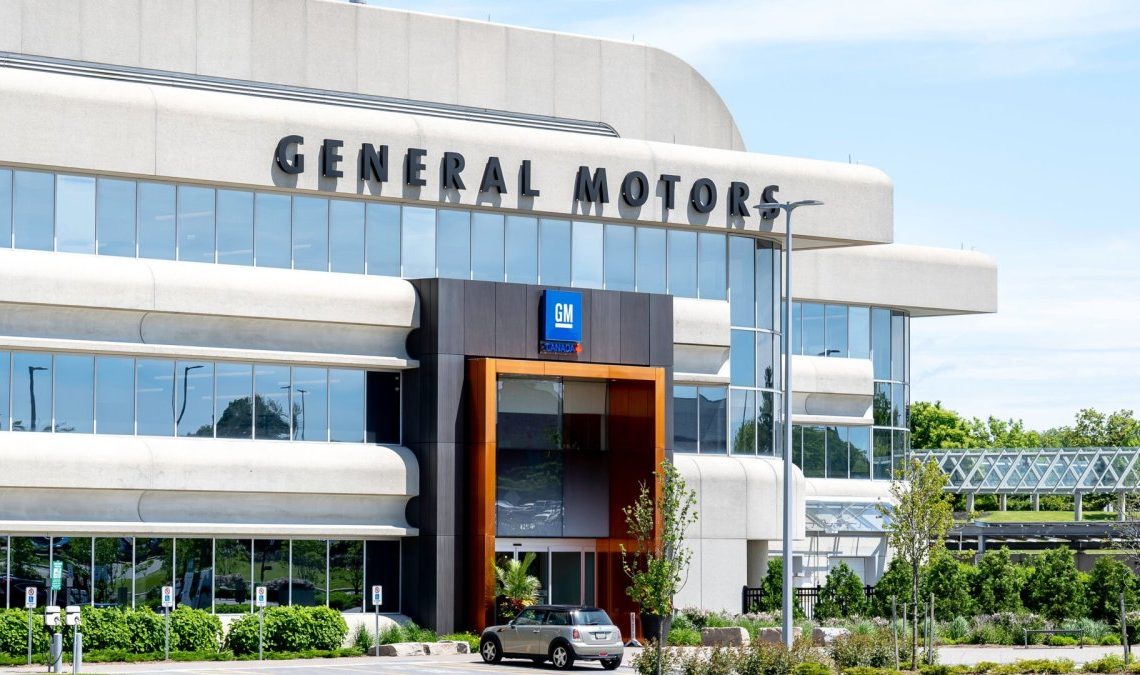
Valued at a market cap of $73 billion, General Motors is among the largest automobile companies in the world.
The Detroit automaker recently announced a 20% dividend bump alongside a fresh $6 billion buyback program after beating Wall Street’s fourth-quarter earnings forecasts. GM stock surged on the news and is now up close to 70% over the past 12 months.
The iconic car maker has rewarded investors who stuck with the company through a year of aggressive restructuring and billion-dollar write-downs.
It’s a bold move that signals confidence, especially after General Motors (GM) took on $7 billion in charges to rightsize its electric-vehicle ambitions and clean up operations in China.
Getty Images JHVE Photo 12022026
GM stock: The dividend math that matters
GM raised its quarterly dividend from $0.15 per share to $0.18 per share. Given an annualized payout of $0.72 per share, GM’s annual dividend expense will be roughly $660 million this year.
Comparatively, analysts forecast its free cash flow at $10.51 billion in 2026, which indicates a payout ratio of just 15%. GM can easily double its dividend payout and still has enough room to invest in growth projects and lower balance sheet debt.
More Dividend Stocks:
- Is JEPI’s massive dividend payout ideal for retirees?
- 57-year-old Dividend King makes $5 billion move to protect payout
- Is Macy’s dividend safe after massive store closures?
According to data from Tikr.com, GM is projected to raise the annual dividend per share to $0.96 per share by 2029.
Here’s what investors need to know about GM’s dividend profile:
Key GM Stock Dividend Metrics:
- New quarterly dividend: $0.18 per share (up from $0.15)
- Annual dividend: $0.72 per share
- Dividend yield: Approximately 0.9%
- Payout ratio: Roughly 15% of FCF
- 3- year Dividend growth rate: 26% CAGR
The aggressive share buyback program has been just as important as the dividend itself. GM has retired more than 465 million shares since late 2023, a 35% reduction that has improved per-share metrics and pushed the stock higher.
With another $6 billion authorized for repurchases, the company clearly believes its shares remain undervalued despite the recent run-up.
GM delivers when it counts
General Motors posted adjusted earnings of $2.51 per share in Q4, crushing analyst expectations of $2.20.
Revenue came in slightly light at $45.3 billion versus the $45.8 billion Wall Street wanted, but nobody seemed to care much about that miss.
The real story is what comes next.
- GM’s 2026 guidance calls for adjusted earnings between $11 and $13 per share, right in line with the analyst consensus of $11.73.
- The company expects to generate between $10.3 billion and $11.7 billion in net income this year, powered by a return to its target profit margins in North America.
- CEO Mary Barra told investors the automaker expects North American margins to return to the 8%-10% range this year, after slipping to 6.8% in 2025.
- That’s a critical milestone after GM absorbed $3.1 billion in tariff costs and took massive charges to scale back EV production.
Barra stated:
What’s driving GM’s business
GM’s strength remains anchored in North America, where it continues to dominate full-size trucks and SUVs. The company held a commanding 60% market share in full-size SUVs last year and posted its highest U.S. market share in a decade.
The automaker also proved it can make money at lower price points. GM sold over 700,000 vehiclespriced under $30,000 in 2025, with models like the Chevrolet Trax and Buick Envista attracting new customers without eroding margins.
Related: General Motors makes harsh decision affecting over 1,000 workers
That’s a big shift from the old GM playbook of making all the money on expensive trucks and losing it back on cheap cars.
CFO Paul Jacobson highlighted the company’s improved cash generation, noting that annual free cash flow has jumped from $3 billion to $10 billion over the past five years.
That consistent cash generation is what’s funding both the dividend increases and the buybacks.
“We didn’t earn a discount in the market overnight,” Jacobson said.
Navigating the tariff mess
Tariffs remain a headwind, but GM managed them better than expected in 2025. The company absorbed$3.1 billion in tariff costs, below its initial forecast of $3.5 billion to $4.5 billion.
Looking ahead, GM expects another $3 billion to $4 billion in tariff-related expenses this year, assuming the 15% tariff rate on South Korea remains in place.
GM is the second-largest U.S. importer of vehicles from South Korea, behind Hyundai, and relies heavily on Korean plants for entry-level models.
The company is actively working to offset tariff costs through manufacturing moves, including plans to produce nearly 2 million vehicles annually in the U.S. by 2027.
GM hit by EV reality check
GM’s $7.6 billion in charges during the second half of 2025 marked a painful but necessary reset of its EV ambitions.
The auto heavyweight wrote down assets related to its discontinued BrightDrop electric van, the conversion of the Orion Assembly plant from EV to ICE production, and supplier contracts that were no longer economically viable.
Barra insists GM isn’t giving up on EVs, just aligning capacity with actual demand rather than regulatory fantasies.
It addednearly 100,000 new customers through EVs last year and plans to continue improving profitability by leveraging new battery technologies, such as LMR, which should reduce cell and pack costs by several thousand dollars.
But for now, GM is doubling down on what works: profitable trucks, SUVs, and the software services business that’s growing fast behind the scenes.
That’s good news for dividend investors.
Related: General Motors receives final grades from analysts ahead of Q4 earnings